Hey there, let’s cut to the chase—if you’re here asking, “How much does an automotive relay production line cost?” you’re probably not just browsing. You’re either scaling your automotive parts shop, looking to add relay production to your lineup, or replacing an old line that’s giving you way too much headache. And yeah, as someone who’s been selling and tuning these lines for over a decade, I can tell you it’s not a one-number answer. But I’m gonna break it down like we’re chatting over a coffee, no fancy jargon that makes your eyes glaze over. Automotive Relay Production Line

First off, let’s get on the same page: what even is an automotive relay production line? It’s not just a few machines stamping parts. It’s a full flow—from blank copper coil turning into a winding, to plastic housing molding, contact assembly, testing, packaging, even palletizing. And relays have to meet super strict automotive standards (ISO/TS 16949, right? Or the new IATF 16949) because they’re in cars, trucks, electric vehicles (EVs), all that. Cut a corner here, and you’ve got a recall that’ll cost you way more than the line itself.
Now, the cost. Let’s start with the low end, but be real—this is only for super basic, semi-automated lines that can barely keep up. Like, if you’re making 50,000 relays a month tops, and most steps are done by hand. That line would run you around $50,000 to $100,000. But here’s the catch: it’s slow, error-prone, and can’t handle the high-volume, high-precision stuff most auto makers want these days. I had a client a couple years back who went this route to save cash, and within 6 months, they were missing deadlines for a local trucking company because their line broke down every other day. They ended up dumping it and upgrading to a full automated line—wasted $70k just like that. Not worth it.
The sweet spot for most small to mid-sized auto parts shops, or new entrants that want to compete, is a semi-automated to fully automated line that makes 100,000 to 500,000 relays a month. This is where most of my sales land. For this, you’re looking at $200,000 to $800,000. Wait, that’s a huge gap—why? Because what you put in is what you get. Let’s break down the variables here, because that’s the stuff no one tells you in generic blog posts.
First, automation level. A semi-automated line has humans loading parts, checking quality at key steps, and doing some manual assembly. That’s cheaper, but you’re relying on skilled labor, which is hard to find these days. A fully automated line has robots, vision systems that check for defects in 0.2 seconds, and data logging for every single relay—so auto makers can prove every part is traceable. For example, the robot that winds the copper coil: a basic winding machine is $15k, but a servo-driven one that’s precise enough for EV relays (which use thinner wires and tighter tolerances) is $50k+. That adds up fast.
Next, product mix. If you’re only making one type of relay—like a standard 12V automotive relay for gas cars—you can get a dedicated line that’s a bit cheaper. But if you want a flexible line that can switch between 10 different relay models (from 5V for sensors to 48V for EV powertrains) without retooling every week, you’ll pay more. I helped a client last year who needed flexibility for a big OEM that changes relay designs every 6 months. Their line cost $650k, but they didn’t have to shut down for weeks to retool—saved them way more in the long run.
Then there’s quality and testing. This is non-negotiable for automotive, but the testing gear varies a lot. Basic lines test for continuity and resistance—cost maybe $20k for that. But modern lines need high-voltage testing (for EV relays that handle 400V or 800V), thermal cycling (to make sure it works in -40°F to 185°F), and even shock/vibration testing (for rough roads). That testing station alone can run $100k to $250k. And if you want traceability—every part has a QR code that links to its production data—you need software integration, which adds another $30k to $80k depending on how fancy the system is.
Don’t forget capacity, which I touched on earlier. Lines that make 500k to 2 million relays a month are the high-volume ones for big OEMs, major suppliers, or EV parts makers. Those start at $900,000 and can go up to $3 million or more. I installed a line last year for an EV startup that needed 1.5 million 48V relays a month. It was fully automated, had 12 robots, advanced testing, and even a packaging line that packs them into OEM-specific boxes. That line cost $2.2 million. But their contract was worth $12 million a year, so it paid for itself in 8 months. No joke.
Now, what about hidden costs? Everyone forgets these, and they’ll make your line way more expensive than the base price. First, installation. A full automated line needs to be leveled, hooked up to power (some use 3-phase, which you might not have), connected to your factory’s air supply, and calibrated. That’s $10k to $50k, depending on the size. Then training—your guys can’t just hit the “start” button and know how to fix it when the robot jams. I include 2 weeks of on-site training in my line quotes, but if you need extra training for your maintenance team, that’s $2k to $5k a day.
Spare parts and downtime. Cheap lines use generic parts that break all the time. My lines use branded parts that are easy to source, but you still need a spare set for the most common parts (like robot grippers, winding needles). That’s $5k to $15k upfront. And if your line is down, you’re losing money—so most clients get a 24/7 support contract, which is 2-3% of the line’s cost a year. Worth every penny, trust me.
Also, standards compliance. IATF 16949 is non-negotiable for working with major auto OEMs. Some lines come pre-certified, but if yours doesn’t, you’ll need to get it audited, which can cost $10k to $30k. And if you’re making EV relays, there’s extra testing for thermal runaway resistance—add another $5k to $10k for that.
Wait, is there a way to save cash without cutting corners? Yeah, if you’re smart about it. First, buy a line that’s slightly under your current capacity, but has room to expand. A lot of my clients buy a line that does 300k relays a month, then add a module in 2 years when demand picks up. That’s way cheaper than buying a huge line you’re not using now. Second, consider used lines, but be careful. I’ve seen used fully automated lines for $100k to $200k, but only if you know exactly how old they are, how many hours they have, and if they’ve been maintained. Last year, a client bought a used line from a factory that shut down, and it had 10 years of heavy use—broke down 3 times a week. They ended up replacing most of the parts for $80k, so it wasn’t a savings at all. Used only if you get a full inspection from a third party, or from a reputable supplier like me who refurbishes them with new parts.
Another tip: bundle services. I offer line cost + installation + training + 1 year of free support for a better price than buying each separately. Most suppliers do that, but don’t be afraid to ask. And if you’re just starting out, maybe start with a semi-automated line with room to add automation later. That way, you don’t tie up all your cash upfront, and you can upgrade when you start getting big orders.
Let me give you real examples from my own clients, because numbers are useless without context. Client 1: Small auto parts shop, makes standard 12V relays for gas cars, wants to make 200k a month. Bought a semi-automated line, fully calibrated, with basic testing, no fancy traceability. Total cost: $280k. They now supply 3 local repair shops and a small regional trucking company, turned profit in 14 months. Client 2: EV parts supplier, needs 1.2 million 48V relays a month, full traceability, high-voltage testing, flexible for new models. Total line cost: $1.8 million. They have a 3-year contract with a major EV maker, so ROI in 10 months. Client 3: Startup, wanted to test a new relay design before scaling. Bought a modular line that can switch between low and medium volume. Total cost: $450k, and they’re scaling to 800k a month now, adding an automation module next year.
So putting it all together: the average cost for a production line that’s actually useful for automotive (no joke semi-automated garbage) is between $250k and $1.5 million, depending on automation, capacity, and features. If you go way under $200k, you’re probably getting a line that’ll cause you more problems than it solves. Way over $2 million, and you might be paying for extra features you don’t need yet (like a full palletizing robot if you’re packaging by hand now).
Wait, but one more thing: don’t just look at the upfront cost. Look at the total cost of ownership over 5 years, which is the typical lifespan of these lines. A $500k line that runs 95% of the time, has low downtime, and can keep up with orders is way better than a $200k line that runs 60% of the time because it breaks. I always tell clients to calculate: how much revenue will I lose if my line is down 2 days a week? How much will I save in labor with automated testing? That’s the stuff that matters, not the sticker price.
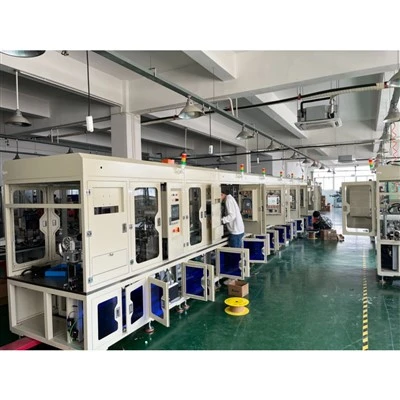
If you’re sitting there thinking, “Okay, I need this, but I don’t know what exactly to get,” hit me up. I don’t do one-size-fits-all quotes. I’ll ask you how many relays you need a month, what type of relays (gas, EV, 12V, 48V), if you need traceability or testing, and build a line that fits your budget and your needs, no hidden fees. No pressure, just honest advice from someone who’s been in this game long enough to know what works and what doesn’t. Stop guessing and start making relays that actually meet auto standards—let’s chat.
Rear Testing Production Line References:
- International Automotive Task Force. IATF 16949:2016 Automotive Quality Management Systems Requirements, 2016.
- Society of Automotive Engineers. Surface Vehicle Recommended Practice J1455: Environmental Conditions and Test Procedures for Heavy-Duty Vehicle Components, 2021.
- Automotive Manufacturing Solutions. "Key Factors in Designing a Relay Production Line for EV Applications," 2023.
- National Institute of Standards and Technology. "Cost Estimation for Flexible Manufacturing Systems in Small to Medium Enterprises," 2022.
Yangning (Xiamen) Intelligent Technology Co., Ltd.
With abundant experience, we are one of the most professional automotive relay production line manufacturers in China. As we have world-leading production equipment and strong manufacturing capabilities, we warmly welcome you to buy bulk advanced automotive relay production line from our factory. Customized orders are welcome.
Address: Room 307-2, No. 15 Duiying Road, Software Park Phase III, Torch Hi-Tech Zone, Xiamen, Fujian, China
E-mail: mia@ynautos.com
WebSite: https://www.ynautos.com/
