If you’ve ever needed a transmission line built in a remote area, or just noticed those sleek, single-pole towers standing along highways or in farmland, you’ve probably wondered: how long does it actually take to put one of those monopole transmission towers up? As a supplier of these towers, I get this question at least a few times a week—whether it’s from a utility manager planning a new project, a contractor trying to line up timelines, or even a curious landowner who wants to know when the construction crew will be on their property. The answer isn’t as simple as “a day” or “a week,” though. It depends on a bunch of factors that I’ve picked up on over the years working with crews across North America. Monopole Transmission Tower
First, let’s break down what “installation time” even means here. A lot of folks mix up the time it takes to set the tower itself with the work that happens before and after. That’s a big mistake, because prep and finishing work can add more time than the actual tower build. I’ll start with the variables that shift the timeline, then walk you through a typical project step by step, so you can see exactly how we get from a cleared site to a working tower.
First up: site conditions. This is the biggest one I see changing timelines. If we’re building on flat, dry farmland with soft but stable soil? That’s easy. We can get a drill or auger truck in there in an hour, dig a hole, set the base, and move on. But if the site is on a hillside, has rocky soil, or is within a few feet of a wetland or a protected tree stand? Suddenly that’s way slower. Last year, we had a job in western Pennsylvania where half the site was solid sandstone. The crew had to use a jackhammer attachment instead of a regular auger, and it took three full days just to drill the foundation hole—something that would’ve taken 4 hours on flat ground. Also, if the site is hard to get to, like in a mountain valley or down a long dirt road, we have to factor in transport time for the tower sections, equipment, and crew. If the tower is 120 feet tall, it can’t fit on a regular semi-truck—we have to split it into 2 or 3 sections, and sometimes even bring a crane in that’s big enough to lift the whole top section, which might need extra time to set up and move into position.
Then there’s the size of the monopole itself. Not all monopoles are the same. A small one, like 60 feet tall, might be for a local distribution line carrying power to a few neighborhoods. A bigger one, 150 feet or more, is for transmission lines moving power between substations. The bigger the pole, the more material it needs, and the heavier the base. A 60-foot monopole might have a base that’s 8 feet deep and 4 feet wide, while a 150-foot one needs a 10-foot deep, 6-foot wide foundation. That means more concrete, more digging, and more time to let the concrete cure. Wait, right—curing time is another thing. I know some people expect the foundation to be ready the same day it’s poured, but concrete takes time to get strong enough to hold a tower. Usually, we let it cure for 3 to 7 days, depending on the weather. If it’s hot and dry, it cures faster; if it’s cold or rainy, it can take longer. Last winter, we had a project in Minnesota where the temperature dropped to 20 degrees Fahrenheit, so the concrete curing time doubled—we had to wait two weeks before we could even start lifting the tower.
Now, let’s talk about the actual build process, step by step, for a standard 100-foot monopole transmission tower (that’s one of the most common sizes we supply). Let’s use a flat, accessible site as our example, so we can show the ideal timeline first, then note where delays pop up.
Step 1: Site prep. This is the first thing that happens. A crew comes in to clear any trees, brush, or debris from where the tower will sit. They also grade the area to make sure there’s no standing water, which would mess with the foundation. For a 100-foot tower, this usually takes 1 day. If there are a lot of trees or the site is uneven, it can take 2 days.
Step 2: Foundation work. This is where the hole is dug, rebar is put in (to reinforce the concrete), and the concrete is poured. For our 100-foot tower, the hole is about 9 feet deep and 5 feet wide. Digging that on flat ground takes 2 to 3 hours. Then we install the rebar cage and pour the concrete. That part takes about half a day. But like I said earlier, we can’t skip the curing time. We wait 5 full days after pouring before moving to the next step. That’s non-negotiable—if we lift the tower too soon, the foundation can crack or shift, which is a safety hazard.
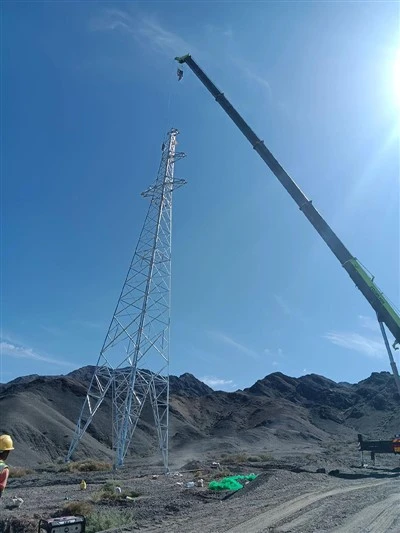
Step 3: Tower assembly and erection. This is the part most people see. The monopole comes to the site in 2 or 3 sections (a base section, middle section, and top section) because it’s too long to transport as a single piece. A crane lifts the first (base) section onto the foundation, bolts it down, then the middle section, then the top. For a 100-foot tower, this usually takes 1 day—if the crew is experienced and the site is flat. But wait, if the crane has to be set up on uneven ground, or if the sections don’t line up right (which sometimes happens if there’s a small defect in the manufacturing, though we do quality checks to avoid that), that can add a day or two. Also, after the tower is up, we have to install the cross-arms, insulators, and the transmission line hardware. That’s another half a day of work, usually.
Step 4: Testing and finishing. Once the tower is up, we need to make sure it’s level, the bolts are tight, and there are no issues with the electrical components. We also add any grounding equipment, which is required for safety to prevent lightning damage. This takes about half a day. Then, once the utility does their final inspection, the job is done.
So adding all that up for our ideal site: 1 day prep + 5 days curing + 1 day erection + 0.5 days testing = 7.5 days total. But that’s the best case. Most of the time, it’s a bit longer. Let’s say the site is a bit rocky, so digging the foundation takes 1 extra day, curing is 6 days instead of 5, and erection takes an extra day because the crane needed to be adjusted. Now that’s 1 + 1 + 6 + 1 + 0.5 = 9.5 days. If we’re talking about a bigger tower, like a 150-foot one for high-voltage transmission, the timeline jumps even more. The foundation is bigger, so curing takes 7 to 10 days, the tower has 4 sections instead of 3, and erection takes 2 days. That pushes the total to 12 to 15 days, on top of any site delays.
I’ve seen timelines go way off the rails, too, and it’s almost always due to something out of our control. Last year, a project in Texas got delayed 3 weeks because a bunch of rain flooded the site, making it impossible for the drill truck to get in. Another time, a tower we supplied had a small manufacturing flaw in one of the flanges, so the crew had to wait 2 days for a replacement section to be shipped. That’s why we always build in a buffer of time, both for us as suppliers and for our clients.
Wait, also, let’s not forget about permitting. A lot of people ask me why it takes so long before construction even starts, and the answer is usually permitting. You can’t just put a transmission tower anywhere—you have to get approval from local governments, utility companies, and sometimes environmental agencies if the site is near a protected area. Permitting can take anywhere from 2 weeks to 3 months, depending on the location. That’s a huge part of the total timeline that people don’t account for when they ask “how long does installation take?” It’s not just the physical work on the site; it’s the red tape before and after.
As a monopole transmission tower supplier, my job isn’t just to deliver the tower—it’s to give our clients a realistic timeline, from start to finish. That means walking them through all the factors I just mentioned, so they don’t get surprised when the project takes longer than they expected. For example, if a client is building in a remote area with rocky soil, we’ll tell them upfront that they should plan for at least 2 weeks for installation, not 7 days. If they’re in a flat suburban area with easy access, we can give them a more tight timeline, like 10 days.
Another thing I should mention: labor availability. If there’s a big project in the area, like a highway expansion or another transmission line, crane operators and construction crews might be booked up. That can add delays to when the crew can actually show up to build the tower. We work with a network of trusted contractors, so we can usually help our clients line up a crew quickly, but sometimes it’s out of our hands.
I’ve had clients come to me saying “we need the tower up in 5 days,” and I have to explain that it’s not possible. Even the fastest installation I’ve ever seen was for a small 60-foot distribution tower on a flat site: 3 days total, and that was a crew that had been working 12-hour days to get it done. But that’s a small, low-stakes tower, not a transmission tower that has to hold high-voltage lines safely. Safety always comes first, so we never rush the foundation curing or the final tests.
At the end of the day, the installation time for a monopole transmission tower isn’t a fixed number. It’s a range, usually between 7 days for a small, simple site up to 3 weeks for a larger, more complex project. Sometimes it’s even longer if there are unexpected delays, like weather, permitting holdups, or equipment issues. That’s why it’s so important to work with a supplier who’s experienced, like us, because we can walk you through every step, anticipate possible delays, and give you a timeline that’s realistic.
If you’re planning a transmission line project and need a monopole tower, or if you have more questions about installation timelines, feel free to reach out to our team to discuss your specific needs. We can help you figure out exactly what timeline to expect based on your site, the size of the tower, and your project requirements. Don’t hesitate to connect with us to get the details sorted out.
Monopole Transmission Tower References
- North American Electric Reliability Corporation (NERC). (2021). Transmission Structure Installation Best Practices.
- American Society of Civil Engineers (ASCE). (2020). Design and Construction of Monopole Transmission Structures.
- International Association of Electrical Inspectors (IAEI). (2022). Electrical Safety Standards for Transmission Tower Installation.
- Federal Energy Regulatory Commission (FERC). (2021). Permitting and Scheduling Guidelines for Transmission Infrastructure Projects.
- Monopole Tower Manufacturers Association (MTMA). (2023). Installation Time Benchmarks for Monopole Transmission Towers.
Hunan Zhubang Hongsheng Construction Technology Co., Ltd.
As one of the most professional monopole transmission tower manufacturers and suppliers in China, we’re featured by quality products and good price. Welcome to buy high-grade monopole transmission tower made in China here and get quotation from our factory. Customized orders are welcome.
Address: Lutang Village, Yong’an Town, Liuyang City, Changsha City, Hunan Province, Hunan Zhubang Hongsheng Construction Technology Co., Ltd.
E-mail: 19898838989@163.com
WebSite: https://www.chinaenerto.com/
