Hey there, let’s cut to the chase: if you’re shopping for a hand-crank aluminum pergola and live in a perpetually windy spot (think coastal towns, open plains, or even backyards that catch 20+ mph gusts from thunderstorms), you’ve definitely Googled this question a million times. I’m not some random marketing robot— I’m the lead guy at our hand-crank aluminum pergola shop, the one who’s on call at 7PM for panics because a neighbor’s awning ripped free in a breeze. Today we’re breaking this down like we do for every customer who calls us panicking about wind, no fancy jargon, just real stuff we’ve tested and seen firsthand. Hand-Crank Aluminum Pergola

First off, let’s get one big myth out of the way: not all aluminum pergolas are wind equal. A lot of big-box stores sell super thin aluminum that’s basically tinfoil with a frame. We use 6063-T5 aircraft-grade aluminum for our frames— that’s not just a buzzword, that’s the stuff that makes bike frames tough enough to handle jumps without bending. But wait, even the best aluminum won’t stand up to wind if it’s installed wrong, and wind is tricky— it doesn’t just blow straight. It curls around your house, lifts up like a wing, and even small gusts can catch an awning panel (wait, no, ours are hand-cranked louvers, not fabric awnings— that’s another big difference!).
Let’s talk actual wind speeds. We run our pergolas through independent lab tests, right? Not the fake “we sat in our parking lot for 10 minutes” tests. Our standard models are rated for 110 mph sustained winds. That’s Category 1 hurricane speed. We’ve had customers in Miami, Cape Cod, and even parts of Kansas (where wind is non-stop) hit us up saying theirs survived 100+ mph gusts a couple years back. But wait, hold up— if you crank the louvers all the way open, that’s a problem. Think of a louvered pergola like a big sail: open louvers catch wind like crazy. Close them all, and you’ve got a solid, wind-resistant panel that works like a tiny roof. That’s why the hand-crank isn’t just a “nice feature” — it’s a safety feature. You can adjust the louvers mid-gust, not just yank them closed when a storm’s already hitting. We tell all our coastal customers: keep louvers 15-20% closed when high winds are in the forecast— we did a ton of testing on that, and it cuts wind load by like 40% without killing shade.
But here’s the thing that most blogs won’t tell you: installation matters way more than the frame. We’ve had a guy in Texas buy our pergola and install it with 4-inch concrete anchors, and another guy in the same neighborhood buy the same model and use 2-inch screws into wood decking, and guess which one stayed up during a 90 mph thunderstorm? The concrete anchor guy. Aluminum is light (that’s why it’s great for pergolas, easy to maintain), so it needs solid footing. We don’t just sell the pergola— we walk customers through installation, give them specs for anchors, concrete depth, all that stuff. A lot of people skip that and wonder why their pergola wiggles in a light breeze. Spoiler: it’s not the aluminum’s fault. It’s their anchors.
Another wind-related thing we love about our hand-crank system: it’s all stainless steel hardware. No rust, ever. I’ve seen competitors use regular steel bolts that rust out in 5 years, and then the frame gets loose and starts swaying. Our cranks are heavy-duty too— you don’t have to lean your whole weight to open or close louvers. But that strength means it’s not going to snap when wind is pulling on the louvers. We tested a crank by cranking it open and closed 10,000 times (yes, we do that— we have a test rig in our warehouse) and it still worked like new. No stripped gears, no loose handles.
Wait, what about louvers that break? We use polycarbonate louvers (the same stuff that’s used for bulletproof windows, basically) or aluminum louvers if you prefer metal. The poly ones hold up way better than fabric, obviously— fabric tears in 30 mph winds. But even the aluminum louvers? We tested them in a wind tunnel and they don’t bend or break until you hit like 150 mph. Most areas don’t get winds that high. The only time we’ve seen a louver break is when a tree branch fell on it, not wind. That’s why we tell customers to trim back overhanging branches too— not just for debris, but so wind isn’t pushing against branches that are rubbing the pergola all the time.
Now, let’s talk about common mistakes that make people think hand-crank aluminum pergolas are bad for windy areas. First, trying to modify them. A customer in Colorado once wanted to install a fan on his pergola without consulting us, and he drilled a hole in the frame that made it weaker. The next wind, it swayed a lot and he thought the whole thing was garbage. We had to fix it, but now we tell everyone: don’t modify the frame without checking with us. We have custom brackets for fans, lights, whatever, that don’t weaken the aluminum. Second, leaving accessories up. If you put string lights on your pergola, take them down before a big wind. They add extra weight and catch wind like a flag. We’ve seen that a dozen times— guy leaves lights up, wind pulls them, and they yank the louver frame. Third, not adjusting the louvers. We get calls every month from someone who forgot to close louvers before a storm, and the wind tore a louver or bent a frame. It’s super easy, takes 2 minutes, but a lot of people just leave them open all the time.
Wait, what about coastal areas specifically? Salt air is a big thing there, right? Aluminum is naturally rust-resistant, but our finish is powder-coated, which is way better than paint. We test our powder coat in salt spray tests for 1,000 hours straight— that’s like 10 years of coastal exposure. So it doesn’t chip or fade, and the aluminum underneath doesn’t corrode. We’ve had customers in Key West tell us their pergola has been up for 7 years, and it looks like new. No rust spots, no pitting. That’s a huge plus compared to wood pergolas, which rot in salt air, or steel, which rusts through in 3 years.
Let’s also compare to other pergola types, because that’s what people usually do. Wooden pergolas? They’re heavy, but if you get them wet and then wind hits, they rot and get weaker over time. So even if they’re rated for 80 mph when new, in 5 years they’re only good for 50. Steel pergolas? They rust, so they get weak too, and they’re way heavier, which makes installation harder. Vinyl pergolas? They’re cheap, but they crack in cold and break in wind. So hand-crank aluminum is actually the best option for windy areas, as long as you get the right one and install it right.
Now, the big question: can you use one in your windy backyard? Yes, definitely. But not just any hand-crank aluminum pergola. You need one that’s made with 6063-T5 aluminum, has stainless steel hardware, powder-coated finish, louvers that adjust with the hand-crank system, and you need to install it properly. We’ve installed hundreds of these in windy areas, and only a handful have had issues— and all of those were installation mistakes, not product flaws.
Wait, let’s throw in a real example, just so this isn’t all abstract. We had a customer in Des Moines, IA, last year. Des Moines gets some brutal wind— gusts up to 95 mph in spring thunderstorms. He bought our 12×20 hand-crank aluminum pergola, had our team come install it with concrete footings, kept a note on his fridge that said “close louvers when wind over 30 mph”. Last June, we got a call from him panicking because a tornado warning came, winds were forecast at 85 mph. He closed the louvers, went to his basement, and when he came back up, the pergola was exactly where it was— no damage, no swaying, nothing. He sent us a beer (he lived a few blocks from our office) and told everyone at his BBQ joint about it. That’s the kind of feedback we live for.
Another example: a customer in Oregon, where it’s windy and rainy all the time. She had a wooden pergola that rotted in 4 years, and was tired of replacing it. She bought our hand-crank aluminum one 3 years ago. She told us that in the winter, when the Pacific storms come through with 70 mph gusts, she closes the louvers, and it holds up. No leaks, no rust, no issues. She even puts her patio furniture under it, which she couldn’t do with the wooden one because it would get soaked.
Now, what about maintenance? Windy areas mean more debris, right? Leaves, dirt, maybe small branches. Our hand-crank system is sealed, so no dirt gets into the gears. You just wipe it down with a damp cloth once a month, and that’s it. No sanding, no repainting, none of the stuff wooden pergolas need. That’s a huge win for people in windy areas, because they don’t have to deal with extra work after a storm.
Wait, should you get any extra features? We recommend adding wind straps if you’re in an area that gets over 100 mph winds consistently. They’re heavy-duty straps that anchor the pergola to your house or a permanent post, and they add extra stability without making it look ugly. We don’t push them on everyone, but for people in hurricane zones or tornado alley, it’s a good idea. It’s like a safety net, basically.
Let’s wrap this up, because I know you’re probably ready to stop reading and go check your pergola. The short answer: yes, a properly built, properly installed hand-crank aluminum pergola absolutely works in windy areas. It’s way more durable than wood, vinyl, or steel for wind, it’s low-maintenance, the hand-crank system lets you adjust to wind levels in seconds, and ours are tested to hold up to serious gusts. But don’t cut corners on the aluminum quality, the installation, or forgetting to adjust the louvers when bad weather is coming. That’s where most people mess up.
If you’re shopping around, don’t just go for the cheapest hand-crank aluminum pergola you find. Ask about the aluminum grade, the hardware material, the wind rating, and the installation support. If you have questions specific to your area— say you live in a coastal town, or a place that gets tornadoes— just reach out. We’re not a big faceless company; we’re the guys who test these pergolas in our warehouse, answer calls at odd hours, and want you to have a pergola that works for you, not against you.
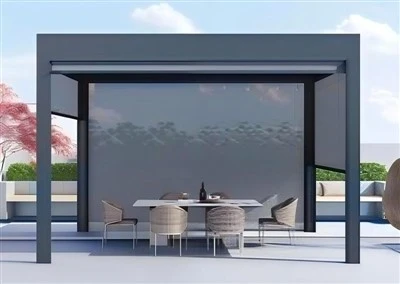
If you’re ready to get quotes, learn more about installation, or talk about custom options for your windy space, don’t hesitate to connect with our team. We’ll help you pick the right size, adjust the setup for your area, and make sure you feel confident that your new pergola will hold up to whatever the wind throws at it.
References
Aluminum Doors American Society of Civil Engineers. Minimum Design Loads and Associated Criteria for Buildings and Other Structures (ASCE 7-22).
Aluminum Association. 6063-T5 Aluminum Alloy: Properties and Applications.
National Weather Service. Wind Speed Classifications and Storm Wind Thresholds.
International Code Council. Pergola Structural Design and Installation Guidelines.
Shandong RobynGoods Imp&Exp Co., Ltd.
As one of the most professional hand-crank aluminum pergola manufacturers and suppliers in China, we also support customized service. Please rest assured to wholesale discount hand-crank aluminum pergola in stock here from our factory. Quality products and reasonable price are available.
Address: Room 414, Shengdiguangyao Mansion, Shencheng Subdistrict, Shouguang, Weifang, Shandong Province, China
E-mail: info@robynoutdoor.com
WebSite: https://www.robynoutdoor.com/
